Vocabulary by lesson
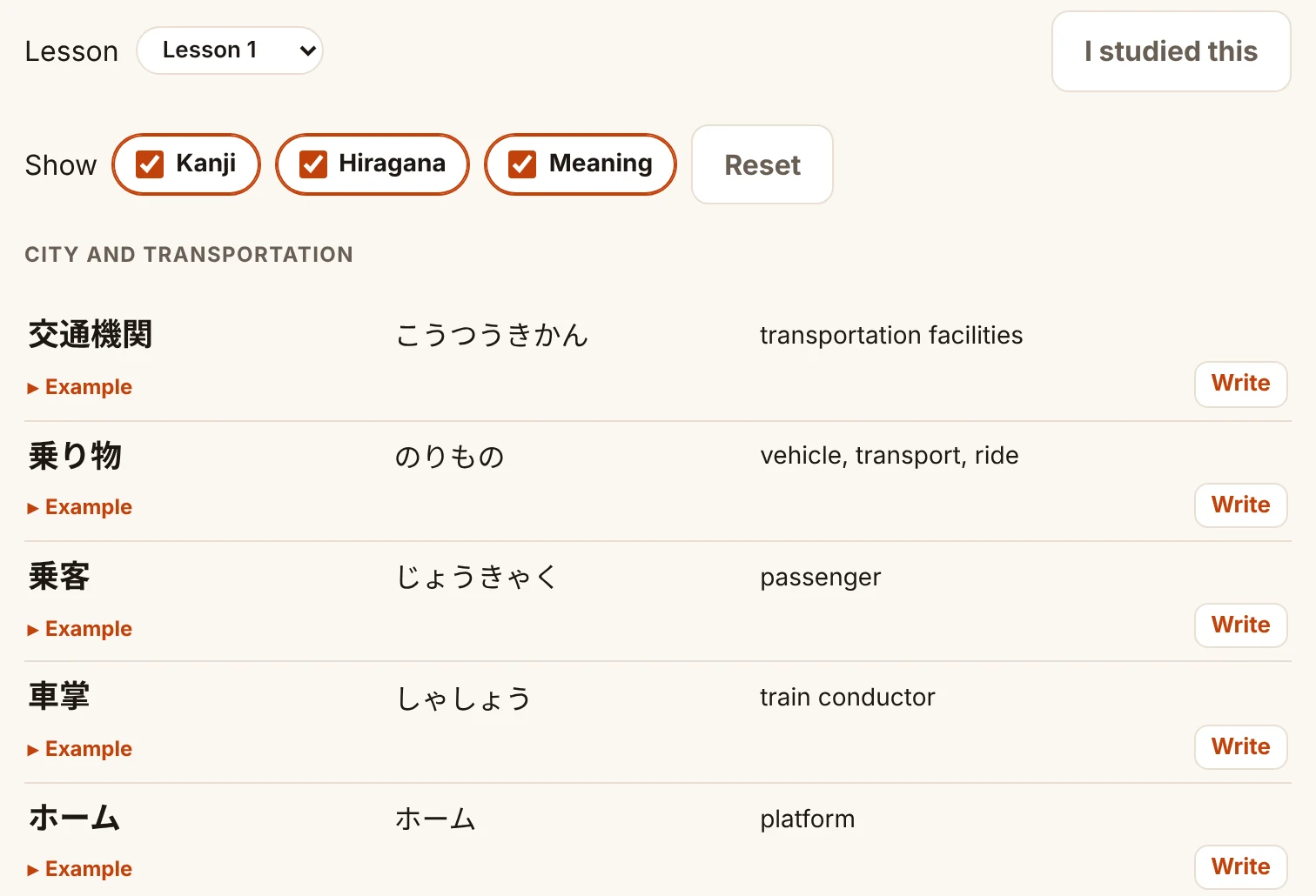
Every lesson lists its words with the kanji, the hiragana and the meaning. Tap Write to use a word yourself.
Take a free 8-minute test. Every mistake turns into a short, fun practice round, so you keep improving without the stress.
Free to try. No account needed for the test.
Studying harder only helps if you study the right thing. Pick a level and watch who gets through.
NihongoSprint finds your gap first, then trains exactly that.
For the exam, and for the Japanese you actually need after it.
Take the free testEight minutes, no account. You see your level right away. A free account unlocks the rest.
Learn it, drill it, write it, review it, then use it in daily life and at work. Pick one to see exactly how it works.
Vocabulary by lesson, grammar by topic, kanji with real words. Study, flip flashcards, then quiz the same lesson.
Start with everything showing. Every word has an example sentence.
Every lesson lists its words with the kanji, the hiragana and the meaning. Tap Write to use a word yourself.
Tap Example, or Show examples for the whole lesson. You see the word in a sentence, with the English.
Flip through the words in a lesson, then tap Again or Got it.
Each kanji with its meaning, its readings and the words you will actually meet.
Ready to check what stuck? Untick a column and it is covered. Say the answer out loud, then tap the cover to check.
Swipe to see more. Tap a screen to enlarge.
See look-alike patterns together, learn when to use each one, then quiz the group.
Pick a group, like Continuation, and see its patterns together before you study them.
Every pattern says when you will use it and shows how to build it, with one example for each form.
The wrong choices are look-alike patterns from the same topic. See why each one fits or does not.
17 question types across vocabulary, grammar, reading and listening, with 5 sets of each per level. Every answer comes with an explanation.
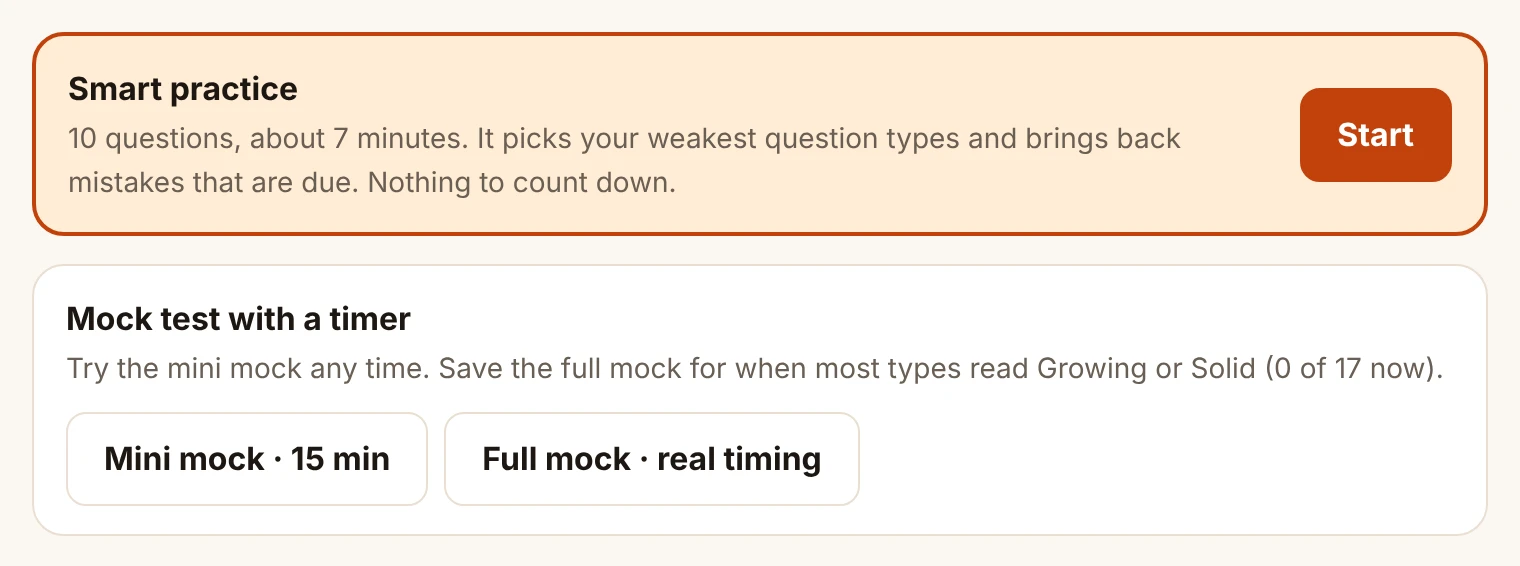
Smart practice picks your weakest question types. Mock tests use real timing.
Smart practice picks your weakest question types. Take a 15-minute mini mock any time, and a full mock with real timing when you are ready.
Kanji reading, orthography, contextually-defined expressions, paraphrases and usage. Five sets of each.
Selecting grammar form, sentence composition and text grammar.
Short, medium and long passages, plus information retrieval.
Task-based comprehension, key points, general outline, verbal expressions and quick response.
Nine short games train what long passages need.
Nine short games train what long passages need, like connectors, tempting wrong answers and who did what.
One of the reading games. Which verb goes with 日程を? You see the meaning, then choose from four.
Every other choice belongs to a different expression, and Sensei shows which one, like 対策を取る or 手を貸す.
You see right away what was right, why each choice fits or not, and what to strengthen.
Pick an answer. You see at once whether it was right.
Not just why you were wrong. You also see what each of the other options means.
After each round you see your strengths and your weak spots, not just a score.
Tap Fix these now. Understand it, try again with a new question, then apply it.
Tap Fix these now. Each weak skill opens with the word or grammar you mixed up, what you picked last time, and the right answer with an example.
A new question on the same skill, so you prove you got it. If you slip, you see why and it comes back.
The skill moves up, with the date it comes back for review. Press Use it to write your own sentence with it.
Memorising a word is step one. Sensei combines AI with a curriculum designed over more than 3 years. It shows what is wrong, why, and the natural way to say it.
Get a prompt for the grammar point you are studying, write your own answer, then read the corrections.
Not only memorising. Pick a grammar point or a word, then use it in your own sentence. Many Japanese words feel alike, so Sensei shows which one fits. You can also practise Kanji words, your mistakes, or a 5-sentence test.
Choose Pass the JLPT, Daily life or Work, then Grammar. Look-alike patterns sit in the same group, so you can try them one after another and feel the difference.
Tap a word from the lesson you are studying and write a sentence with it. You use the word, not just memorise it.
Both 今 and 現在 mean “now”, but 現在 is formal. Sensei shows which one fits when you use the word you chose.
N3 and N2 patterns that learners get wrong. You see what the student wanted to say, what they wrote, the fix, and the reason in plain English.
Swipe to see more. Tap a screen to enlarge.
Describe the situation, pick who you are talking to, and write what you would really say. Sensei checks meaning, politeness and naturalness for that listener.
Swipe to see more. Tap a screen to enlarge.
A free account includes 3 Sensei checks to start.
No two learners miss the same things. NihongoSprint turns your mistakes into the next five minutes of practice.
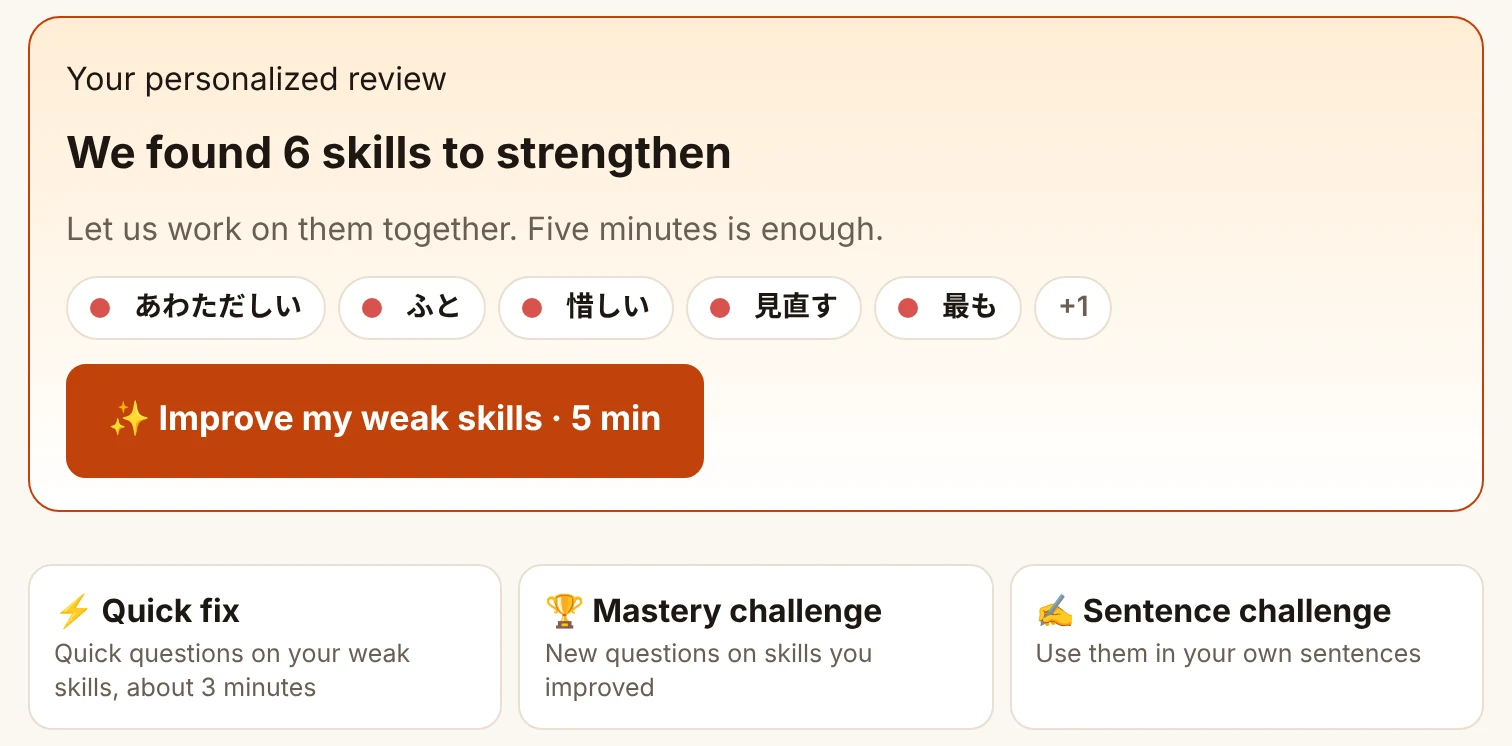
Skills to strengthen come from your own mistakes. One button starts five minutes on them.
Skills to strengthen come from your own mistakes. One button starts five minutes on them. Choose Quick fix, Mastery challenge or Sentence challenge.
Every skill moves from not yet understood to mastered, so you can see your progress.
Each weak skill becomes a short round: see the word you mixed up, try a new question, then use it.
Tap Fix these now. Each weak skill opens with the word or grammar you mixed up, what you picked last time, and the right answer with an example.
A new question on the same skill, so you prove you got it. If you slip, you see why and it comes back.
The skill moves up, with the date it comes back for review. Press Use it to write your own sentence with it.
See what you practised each day, and how your week is going.
See what you practised each day, and how your week is going.
Textbook Japanese gets you through the exam. This part is for the conversation after it: how people really say things, at home and in daily life.
Learn the phrases, listen to a short dialogue, then try them in your own sentence.
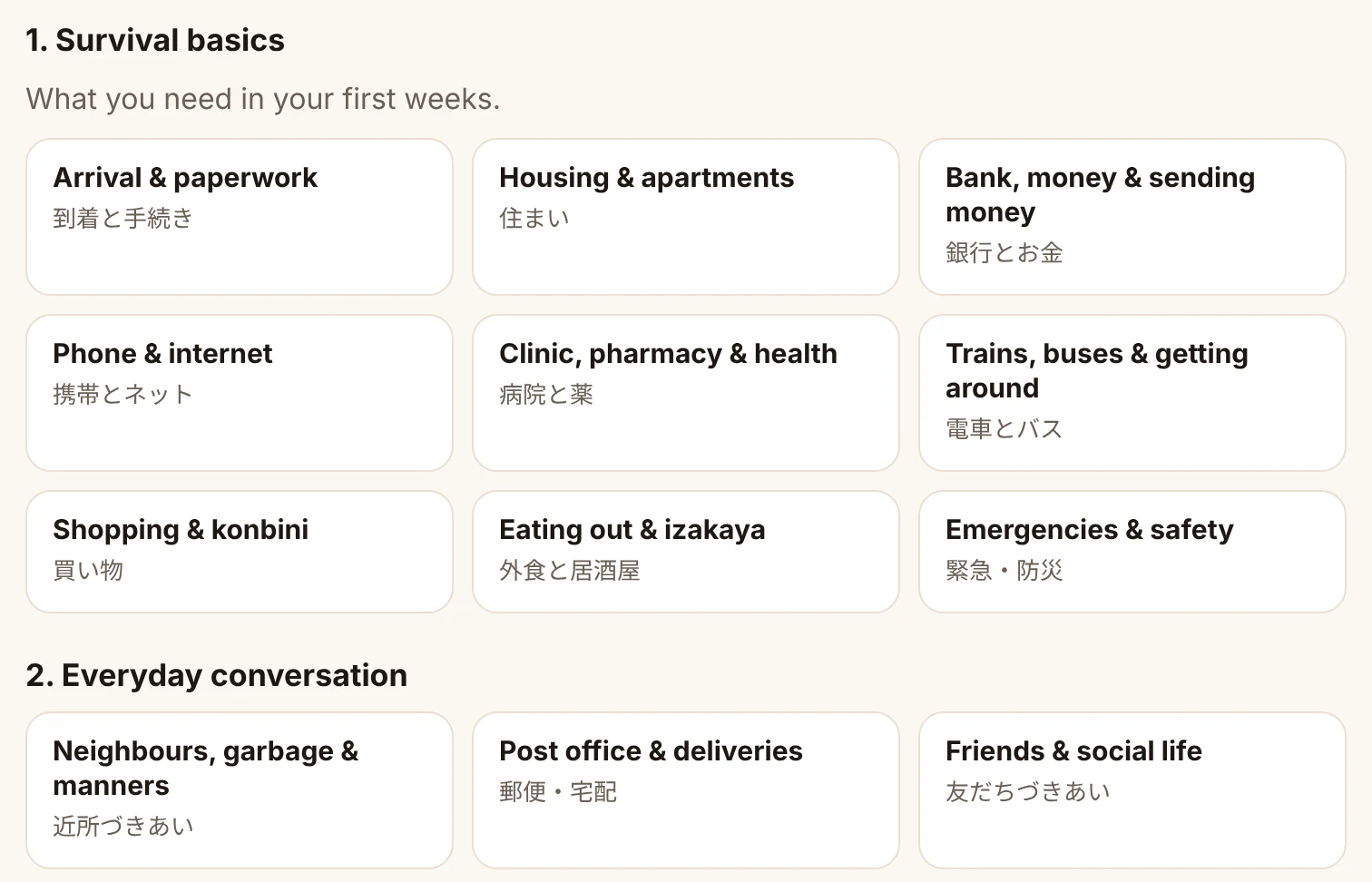
Arrival and paperwork, housing, banks and clinics, trains, shopping, eating out and emergencies. Then neighbours, deliveries and friends.
Open a situation like Shopping and konbini. Listen, tick Got it, or try and apply in your own sentence.
Listen to a short konbini conversation, answer the question, then open the transcript.
Sensei plays the other person. You reply in Japanese, then it coaches understanding, accuracy, naturalness, politeness and the right action. The conversation keeps going.


Set phrases, mimetic words, slang, fillers and casual forms, each with real example sentences and who you would say them to.
Each phrase comes with real situations and who you would say it to.
ぺこぺこ, ぐるぐる and the sounds Japanese uses for feelings and states, with examples.
やばい, マジ, めっちゃ. Each one says whether it is safe at work.
えーと, なんか, ちょっと. The little words that make speech sound natural.
食べちゃった, 見てる, 知らない. How people really shorten words.
Japanese builds verbs like English phrasal verbs: 〜出す, 〜込む, 〜上げる, 〜直す. Learn them in short sentences, then try and apply.
Each verb group comes with real example sentences and the English. Listen, tick Got it, or try and apply.
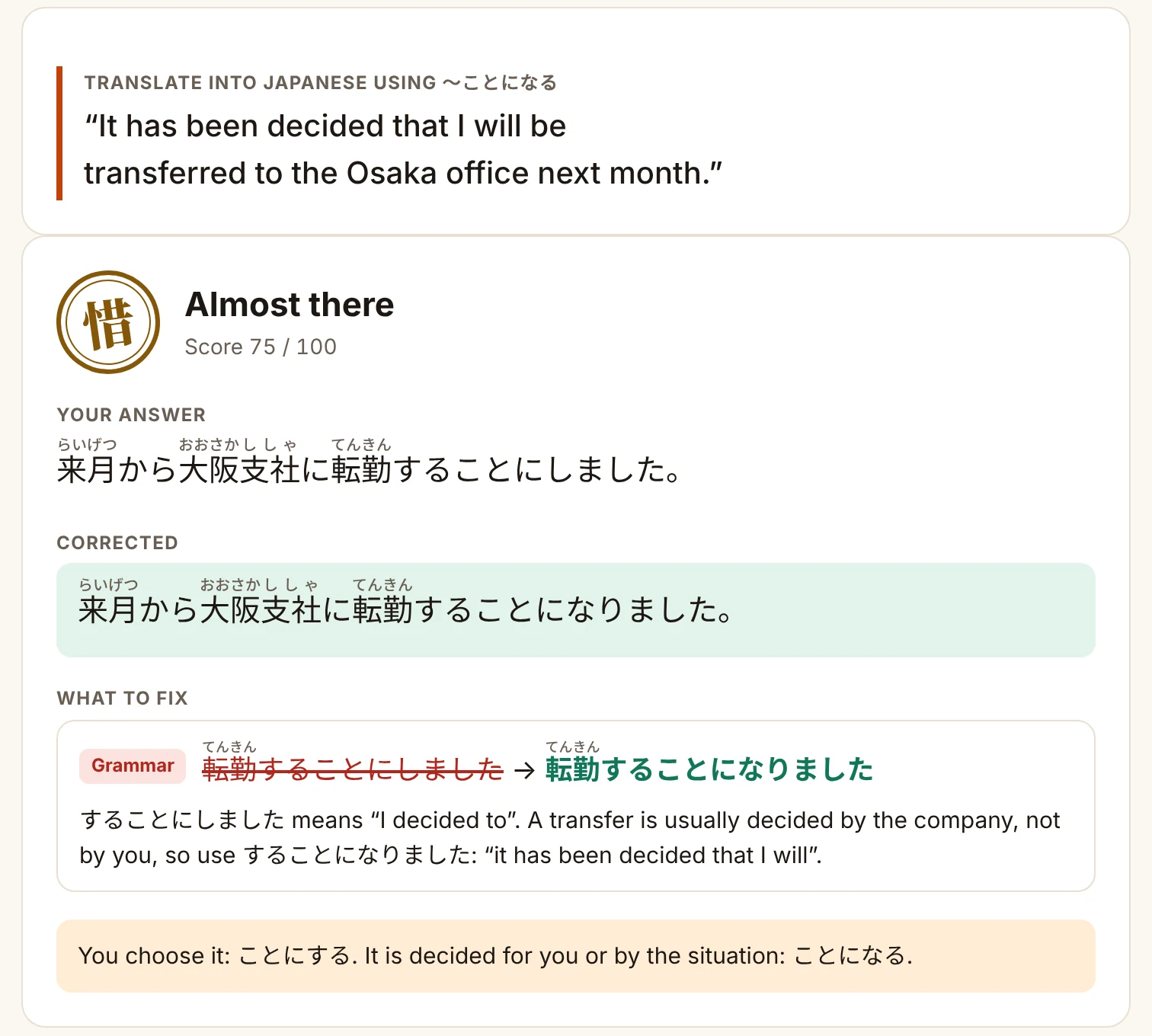
Tap Try and apply. The Japanese is hidden. Read the English and write the sentence yourself.
Tap Check. You see Almost or Correct, what you wrote with the wrong part marked, and the answer. This does not use a Sensei check.
Understand your senpai, report a mistake, ask for help, and practise the phrases of your own industry. Built for the real moments at work.
Many people live in Japan for years, pass the tests, and still go quiet at work. The gap is not vocabulary. It is knowing what to say, to whom, and whether to be polite or casual. That is not a talent problem. It is a missing lesson.
Whatever your job, you need to understand instructions, ask when you do not understand, and report problems. Start here.
Understanding instructions, asking for clarification, confirming deadlines, reporting mistakes, asking for help, and more.
Type what you heard. You get what it means, how it sounds, what to do, and safe replies you can really say.
Short senpai phrases like これ、やっといて. Each one comes with a polite reply.
The words for the hardest moments, and how to say the same thing casually, politely and formally. Swipe to see each one.
Swipe to see more. Tap a screen to enlarge.
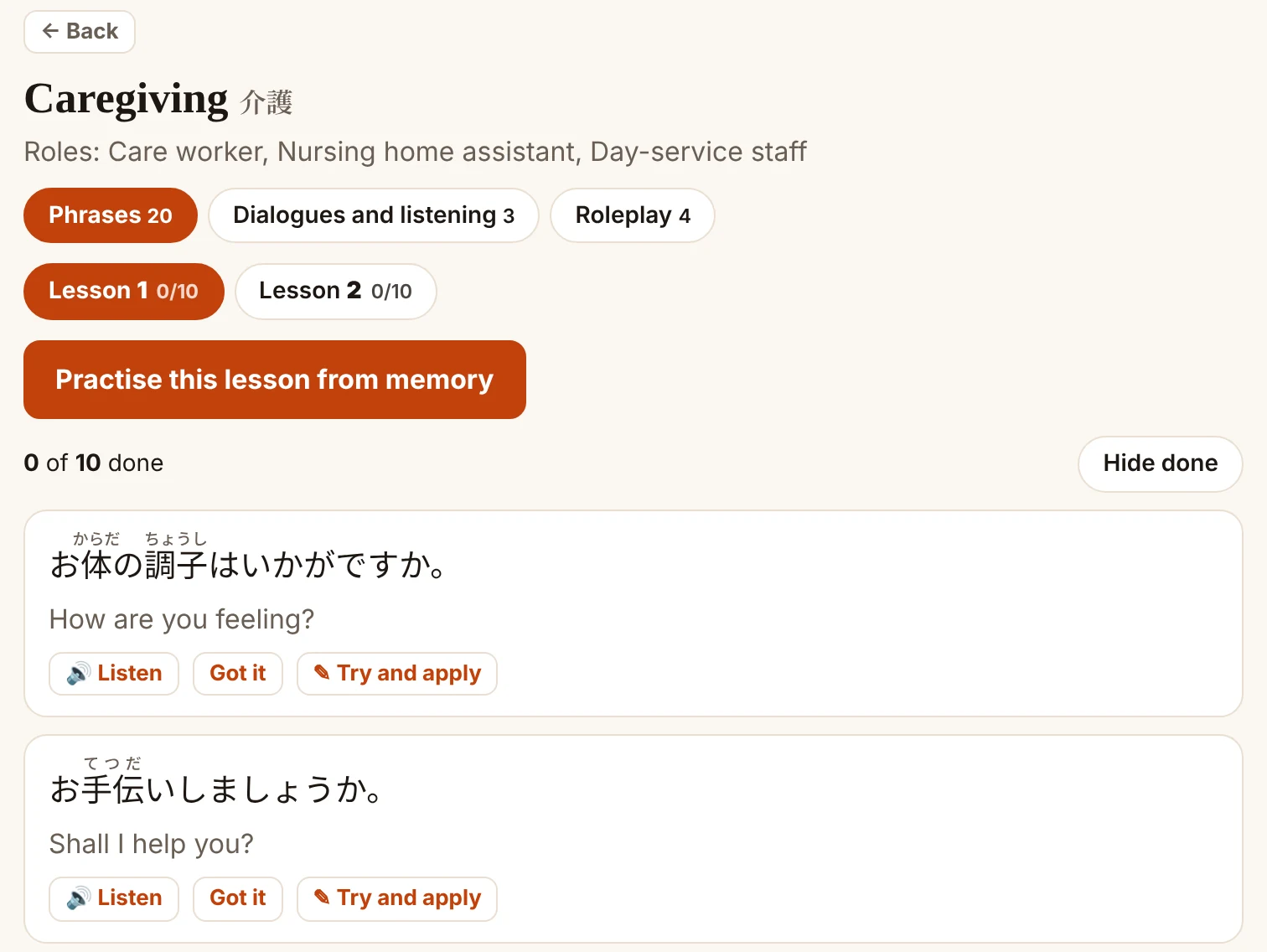
20 industries, from caregiving and manufacturing to hotels, IT and construction. Each one has 20 phrases, 3 dialogues with listening questions, and 4 roleplays.
Choose the job you do. Caregiving, nursing, manufacturing, construction, restaurants, hotels, agriculture, IT and more.
Phrases you will say to residents, like お体の調子はいかがですか。 Listen, tick Got it, or try and apply.
Phrases for the line, like 不良品が出ました。 A defective product was found.
Short dialogues from the job, with listening questions. Open the transcript only after you try.
A morning round in a care home. Play it, answer the question, then open the transcript.
The phrases for the front desk: asking for a name, check-in times, asking a guest to wait.
Four roleplays in every industry, like a resident who is dizzy or refuses a bath. Each has a goal.
A caregiving example. Sensei plays the resident, you reply in Japanese, and it coaches understanding, accuracy, naturalness, politeness and the right action.


One path, from your first test to the conversations you actually have.
Start with the test and the free lessons. Upgrade only when you want the full plan and daily Sensei checks.
Billing is handled by Patreon. Cancel any time there.
What is inside, how the tests and the plan work, and what to expect from Sensei.
6,900+ vocabulary words, 1,600+ kanji and 900+ grammar points across N5 to N1. Every word has an example sentence, every grammar point has examples with English, and each kanji comes with real words that use it. Learn has flashcards and a quiz for every lesson. Exam drill adds 17 question types, with every answer explained.
Yes, they follow the exam's formats: kanji reading, orthography, word meaning, paraphrases, usage, grammar forms, sentence order, text grammar, short and long reading, information search and listening. For several types the app writes fresh questions at your level as you use it, so you are not memorising a fixed list.
You pick a 15-minute mini mock or a full mock with the real exam's section timers, for example N3 is 30 minutes of vocabulary, 70 of grammar and reading, and 40 of listening. Listening has audio. At the end you get an estimated score on the JLPT's 180-point scale, shown against the pass mark and each section's minimum, and every question you missed goes into your review.
The placement test estimates your level and scores vocabulary, kanji, grammar, reading and listening. Tell the app your exam date and minutes per day, and it gives you three small steps each day on a calendar. Smart practice then picks your weakest question types. Each type shows New, Needs work, Growing or Solid from your last 12 answers, so you know when to move on.
You write your own sentence, no multiple choice. Sensei scores understanding, accuracy, naturalness, politeness and whether it was the right thing to say, then shows what to fix, why in plain English, and the natural way to say it. Sensei combines AI with a curriculum we have designed over more than 3 years, so the feedback follows what the JLPT and real life ask of you.
Daily situations like the city hall, the clinic and the izakaya, role-plays where Sensei plays the other person, and the Japanese nobody puts in a textbook: set phrases, mimetic words, slang, fillers and casual forms. The work track covers senpai phrases, reporting mistakes, asking for help, the politeness ladder and work culture, with 20 industries on top. Both are part of Pro.
No. It is an estimate from a short adaptive test, a good guide to where to start. Only the real JLPT gives an official result. Mock test scores are estimates too.
You do not need an account to take the test or try the free lessons. A free account unlocks the full breakdown, your study plan, your first 3 Sensei checks, and saves your progress. For speaking, you can hear every work phrase, say it out loud, practise from memory and rehearse role-plays. The app does not listen through your microphone or score pronunciation yet.
Yes. It runs in your browser and is built for phones first, so there is nothing to install. Explanations are available in English, Bahasa Indonesia, Tiếng Việt and 中文. Questions and answer choices stay in Japanese, like the real exam.
Plans run through Patreon. You pay and cancel there, then connect Patreon in the app and Pro turns on straight away. Free stays free.